
Test it before you replace it
Pour five gallons of water into the pit and watch. A pump that starts promptly, moves the water out and shuts off cleanly is a working pump, and a working pump at year five is worth keeping. Do that twice a year — spring and late fall — and you will know the state of the machine without guessing.
When a pump hums but does not move water, or does nothing at all, the odds favor the float switch rather than the motor. The switch is the component that fails most often, and a replacement float or switch assembly costs $15 – $50 against $150 – $400 for a new pump. Check for a stuck float, a tether wrapped around the discharge pipe, or debris jamming the travel before you buy anything larger.
There is also a cheaper product that is genuinely the right one for many houses. In an unfinished utility basement with a concrete floor and nothing stored on it, a pedestal pump at $110 – $220 does the same job as a submersible at $150 – $280. It is louder, and that is the only real drawback in a space nobody sits in. Pay the premium for a submersible where the basement is finished, or where a sealed pit lid matters for humidity and radon control.
What actually decides this purchase
A sump pump is a component whose failure floods a basement, so the specifications worth arguing about are the ones that govern how long it lasts and how it behaves when it is running hard. Four of them decide it.
Submersible or pedestal
Submersible sits in the water — quieter, handles debris, allows a sealed lid for humidity and radon control. Pedestal keeps the motor above the pit — cheaper and easier to service, but loud. The sealed lid is the underrated part of that comparison. A submersible pit can be closed with a gasketed cover, which stops the pit from evaporating water into the basement all summer and gives you a place to terminate a radon vent later. A pedestal pump has a shaft running through the lid, so the pit is effectively open to the room, which matters where radon is a live question.
Horsepower
Follows water volume, not house size. 1/3 HP suits most homes; 1/2 HP suits high water tables or long vertical discharge runs. Oversizing causes short-cycling, which shortens pump life. A 1/3 HP pump typically moves somewhere around 35–45 gallons per minute at a 10-foot lift, which covers the water most homes see in a heavy storm. Step up to 1/2 HP when the discharge has to climb more than about 10 feet, when the horizontal run outside is long, or when the pit refills within seconds of the pump shutting off during ordinary rain.
Cast iron vs plastic housing
Cast iron dissipates heat better and generally outlasts plastic. On a component whose failure floods a basement, the upgrade is cheap. Cast iron pulls heat out of the motor into the surrounding water, so the pump runs cooler during the long continuous cycles that occur exactly when you need it. Thermoplastic housings are lighter and cheaper and are fine in a pit that runs occasionally. The price gap is commonly $40 – $80, against a flooded basement.
Switch type
The switch fails more often than the motor. Vertical float switches suit narrow pits; tethered floats need room to swing. A stuck switch is the most common "dead" pump. Vertical float switches need less side clearance, which makes them the practical choice in a narrow pit or one crowded with pipe. Tethered floats need room to swing and give you a longer draw-down, which reduces cycling in a wide basin. Electronic switches have no moving float at all, though they add a circuit board to the list of things that can fail. Whichever you get, keep the pit clean — gravel and silt cause more stuck switches than wear does.
Horsepower, head and gallons per minute
Manufacturers publish a flow curve, and the only number on it that matters is the flow at your actual lift. "Total dynamic head" is the vertical distance from the pump to the highest point of the discharge, plus friction from the pipe run and every elbow in it. A pump advertised at 60 GPM at zero head might deliver 35 GPM at ten feet and very little at twenty.
Measure the vertical rise from the pump to where the line exits the wall, add roughly a foot of equivalent head for each elbow, and read the flow off the curve at that number. If the result is comfortably above what your pit fills at during a storm, the pump is correctly sized.
Resist the temptation to buy the biggest pump on the shelf. An oversized pump empties the pit faster than water enters it, shuts off, and restarts moments later. That short-cycling is hard on the motor and the switch, and it is a common reason a pump dies at year four instead of year nine. A larger basin, which gives more draw-down between cycles, solves that problem better than more horsepower does.
Options by use case
As an Amazon Associate we earn from qualifying purchases. It doesn’t change your price, and we don’t rank by commission. How we make money
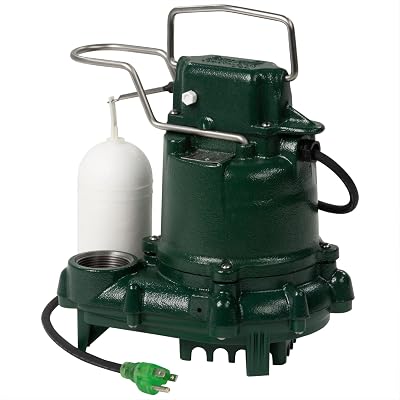
Zoeller M53 Mighty-Mate
- 1/3 HP
- Cast iron housing, switch case and motor
- Float-operated automatic switch
- Non-clogging vortex impeller
The right default for most homes, and the pump most contractors reach for.
Check current price
Wayne CDU980E
- 3/4 HP
- 5,490 GPH
- Cast iron and stainless steel
- Vertical float switch
- 5-year warranty
Choose on discharge height and water volume, not on wanting more power.
Check current price
Superior Pump 92333
- 1/3 HP
- 3,000 GPH
- Lifts water up to 20 ft
- Thermoplastic, stainless impeller
Cheaper and simpler to service; audibly running.
Check current price
Zoeller 508-0006 AquaNot Spin ProPak
- M53 primary pump + 12V DC backup
- 5.5 hrs continuous pumping on a full charge
- Controller with outage and high-water alerts
- Pre-plumbed, check valve and float included
The storms that overwhelm a sump are the storms that cut the power.
Check current priceWhat else the job needs
The pump is one line item. A check valve on the discharge, at $15 – $40, stops the column of water in the pipe from draining back into the pit each time the pump stops — without it, the pump re-pumps the same water and cycles far more than it should. Fit it above the pump and orient it correctly.
The discharge line has to carry water far enough from the house that it does not simply return through the footing drain. Extending or rerouting a discharge run costs $200 – $900. In cold climates, a frozen discharge line is a functioning pump with nowhere to send water, so a freeze-relief fitting or a downward-sloped run with a large open end is worth specifying.
Electrically, the pump belongs on its own GFCI-protected receptacle rather than an extension cord shared with a freezer. And most jurisdictions prohibit discharging a sump into the sanitary sewer — a permit for a new pit and line runs $50 – $250. Installed pricing for the whole job is broken down in our sump pump installation cost guide: $400 – $1,200 to swap a pump in an existing pit, and $1,000 – $3,500 for a new pit, discharge and circuit.
Finally, decide about backup at the same time rather than later. A combination unit puts the primary and a DC backup pump in one basin during a single installation, which is cheaper and tidier than adding a second system to a finished basement two years on.
How sump pumps fail
The switch sticks. Most "dead" pumps have a live motor and a float that cannot move. Keep the pit free of gravel and silt, confirm the float has clear travel, and give a tethered float room to swing.
The power goes out. The storms that overwhelm a sump are the storms that drop the lines. A primary pump alone has a single point of failure that correlates precisely with the weather it exists to handle — which is the argument for a battery backup sump pump.
The pump air-locks. Air trapped in the housing leaves the impeller spinning in a bubble and moving nothing. Most pumps want a small weep hole drilled in the discharge pipe below the check valve; confirm yours has one.
It short-cycles itself to death. Oversizing, a missing check valve, or a basin too small for the inflow all produce dozens of starts an hour. Motors tolerate running; they wear out starting.
It simply reaches its age. Plan on 7 to 10 years and replace on your schedule rather than during a storm at emergency rates. Prices here reflect the 2026 US market and published manufacturer specifications — confirm the flow curve and switch type for the exact model before ordering.
Related guides
- Sump pump installation cost — installed pricing, line by line.
- Battery backup sump pump — the part that matters during an outage.
- Basement waterproofing cost — the drainage system a pump belongs to.
- Wet basement repair cost — diagnosing where the water comes from.
- Basement repair cost — the wider scope of basement work.