
What bowing basement wall repair costs
Most homeowners pay $2,500 – $7,000 to stabilize one bowing basement wall with carbon fiber straps, and $4,000 – $15,000 when the wall has moved far enough to need wall anchors or steel I-beams. The dividing line is roughly 2 inches of deflection, and you can measure that yourself with a string and a tape.
The spread inside each of those ranges comes from three things: the length of the wall, the number of restraints it takes to hold it, and how easy your yard is to work in. A 22-foot wall in a walk-out basement with open lawn on the outside sits near the bottom. A 40-foot wall with a deck, a patio and a mature maple over the anchor line sits near the top, because the crew has to work around all of it.
One figure that surprises people: bracing a wall usually costs less than the drainage work that keeps it braced. Saturated soil is what pushed the wall in, so a lasting repair pairs the hardware with $100 – $600 of gutter and grading correction, or a full drainage system at $2,300 – $7,500 when water is already coming through.
Bowing wall repair cost by line item
| Line item | Typical range | Unit | What drives it |
|---|---|---|---|
| Carbon fiber strap | $400 – $800 | per strap | Wall length; straps sit 4–6 ft apart |
| Carbon fiber — full wall | $2,500 – $7,000 | per wall | 5–9 straps on a typical 30 ft wall |
| Wall anchor | $700 – $1,900 | per anchor | Yard access, depth to stable soil |
| Wall anchors — full wall | $4,000 – $15,000 | per wall | Anchor count and excavation in the yard |
| Steel I-beam brace | $500 – $1,200 | per beam | Floor joist attachment, footing pocket |
| Excavate and rebuild the wall | $20,000 – $40,000 | per wall | The last resort; includes backfill and restoration |
| Structural engineer report | $450 – $600 | per visit | Independent of any contractor |
| Building permit | $75 – $400 | per job | Most structural bracing is permitted work |
| Crack injection along the bow | $350 – $900 | per crack | Seals the horizontal crack after bracing |
| Drainage and grading correction | $100 – $600 | per project | Removes the pressure that caused the bow |
Source: Compiled from published 2025–2026 residential structural repair cost datasets and manufacturer-published installer pricing for carbon fiber and anchor systems, normalized to installed cost including labor. Per-wall totals assume a 28–34 ft poured or block wall. · Last reviewed July 30, 2026 · Reference data · How we compile these figures
Read the per-strap and per-anchor lines as the useful ones. Quotes arrive as a single wall price, and the quickest way to compare two bids is to divide each total by the number of restraints proposed. Two contractors quoting the same wall at $5,200 and $7,800 are often proposing 7 straps and 11 straps — which is a design difference worth asking about, rather than a pricing difference worth haggling over.
Cost by how far the wall has moved
| Measured bow | Typical cost | Scope | What the money buys |
|---|---|---|---|
| Under 1/2 in., stable for a year | $100 – $600 | drainage only | Measure each season; fix gutters and grade |
| 1/2 – 2 in. of deflection | $2,500 – $7,000 | per wall | Carbon fiber straps bonded to the wall face |
| 2 – 4 in. of deflection | $4,000 – $15,000 | per wall | Wall anchors, or steel beams where the yard is tight |
| Over 4 in., or shearing at a mortar joint | $20,000 – $40,000 | per wall | Excavate, rebuild, re-backfill with drainage |
Source: Deflection thresholds follow common residential engineering practice for unreinforced block walls; costs are the same installed-cost dataset applied to the method each threshold calls for. Your local jurisdiction may set its own limits. · Last reviewed July 30, 2026 · Reference data · How we compile these figures
The measurement is the price driver, so take it before you take a quote. Run a taut string or a long straightedge floor to ceiling against the wall, then measure the widest gap at mid-height. Write down the number and the date. That single figure tells you which row above you are in, and it gives you something to compare against in six months.
Straps, anchors or beams — what each one does
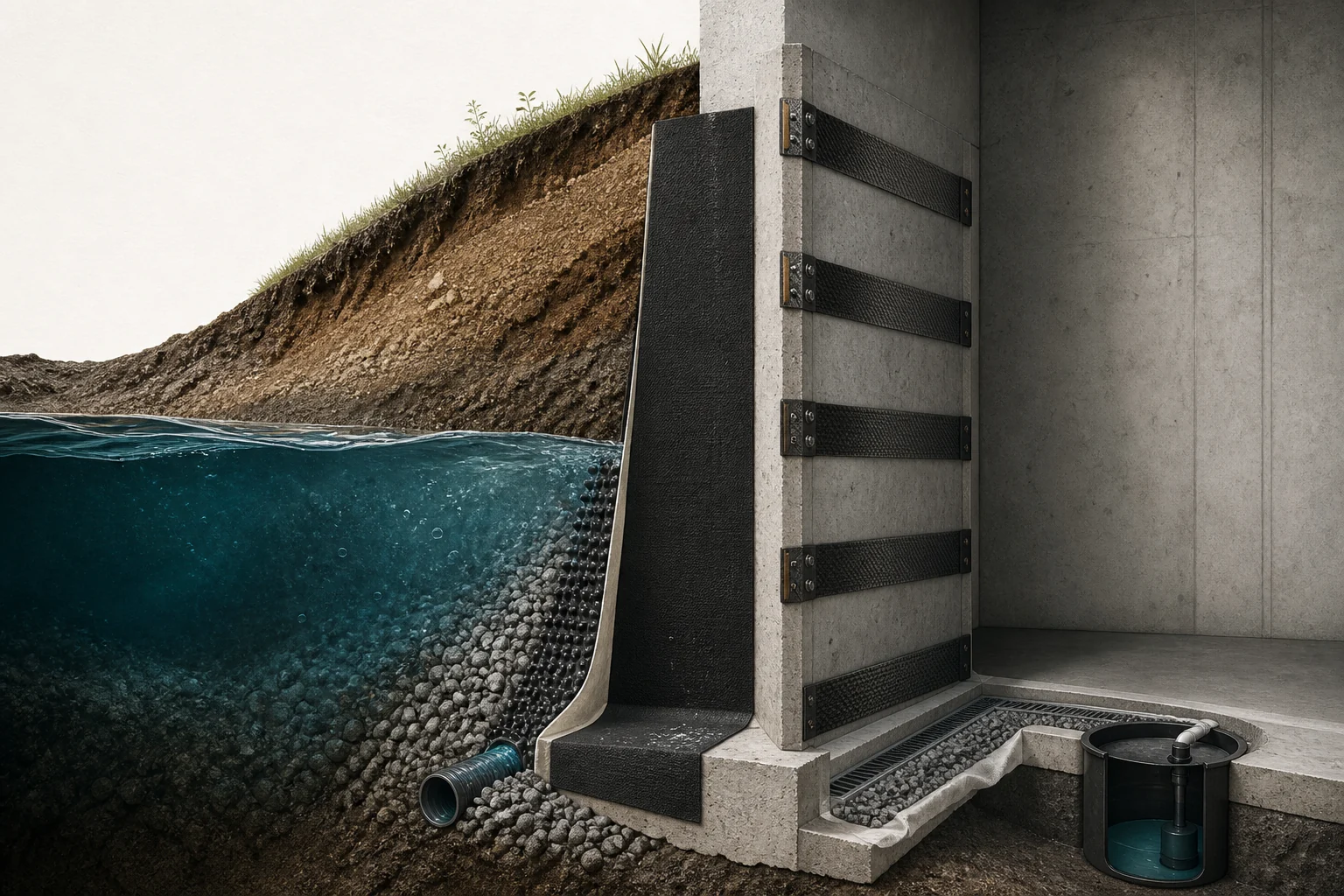
Carbon fiber straps at $400 – $800 each are epoxied to the inside face of the wall and stop further inward movement. They sit flush, so a finished basement can be drywalled straight over them, and installation takes a day entirely from inside. What they do is hold the wall where it is today, which is why the 2-inch threshold matters — a wall further gone than that has lost too much of its own capacity for a surface-bonded strap to carry.
Wall anchors at $700 – $1,900 each run a rod from a plate on the inside wall to a buried plate about 10 feet out in the yard. Because you can tighten them a quarter turn a season, they often recover part of the movement over a few years. They need open, diggable ground on the outside, which is the constraint that usually rules them out.
Steel I-beams at $500 – $1,200 each bolt to the floor joists at the top and seat in the slab at the bottom. They are the answer when the wall has moved past carbon fiber range and the yard cannot be dug — a zero-lot-line house, a driveway, a neighbor's fence at the property edge. They project into the room by several inches, which matters if you were planning to finish the space.
Measure first — you may be spending nothing this year
A wall bowed under half an inch that has held the same measurement through a full wet-and-dry season is doing its job. The reasonable spend there is $100 – $600 on downspout extensions and regrading, plus a note in your calendar to re-measure. Many block walls carry a slight bow from the year they were backfilled and stay exactly that way for decades.
So take the measurement, photograph the string gap with a tape in frame, and repeat it in spring and again in fall. Movement of a quarter inch between readings is the signal to price hardware. A stable number across two seasons is permission to leave it alone and put the money toward the drainage that keeps it stable.
The reason to do this yourself is that a free inspection is a sales call. The company measuring your wall is the company selling the straps, and stability across seasons is information only you can gather, because it takes months.
Get a neutral opinion before a five-figure job
Once a quote passes roughly $5,000, an independent structural engineer at $450 – $600 is the best-value line item on this page. The engineer sells you nothing afterward, so the report says how far the wall has moved, what caused it, and what class of repair it needs — which is precisely the information three competing bids are all interpreting differently.
Bring that report to the bidding. It converts vague quotes into comparable ones, and it gives you a document for the next buyer's inspector, which is worth real money at resale.
Related reading: basement repair cost for the full basement picture, basement waterproofing cost for the drainage side, types of foundation cracks to read the horizontal crack that usually comes with a bow, foundation repair cost for the whole-house view, and the cost calculator for a range built around your wall length.