
Foundation crack severity chart
Six patterns cover essentially every foundation crack. Find yours in the chart, then read the section below it. Cost ranges assume the pattern's typical repair — structural rows are wide because scope comes from an engineer's findings rather than from the crack's appearance.
| Crack type | Repair cost | Severity | Cause and approach |
|---|---|---|---|
| 1 · Hairline vertical (under 1/16 in.) | $0 – 150 | Cosmetic | Curing shrinkage. Monitor, seal only for water or radon |
| 2 · Vertical (1/16 – 1/4 in.) | $350 – 900 | Low | Shrinkage or early settling. Inject to seal |
| 3 · Diagonal (from an opening corner) | $350 – 1,200 | Low–moderate | Differential settling at a stress point. Monitor closely |
| 4 · Stair-step (block or brick) | $800 – 6,000 | Moderate–high | Movement or soil pressure. Engineer advised |
| 5 · Horizontal | $2,500 – 15,000 | High — structural | Lateral soil pressure on the wall |
| 6 · Offset / displaced faces | $5,000 – 30,000 | High — structural | Active movement. Engineer before any quote |
Source: Severity classification follows standard residential structural assessment practice. Cost ranges compiled from published 2025–2026 contractor pricing datasets. · Last reviewed July 30, 2026 · Reference data · How we compile these figures
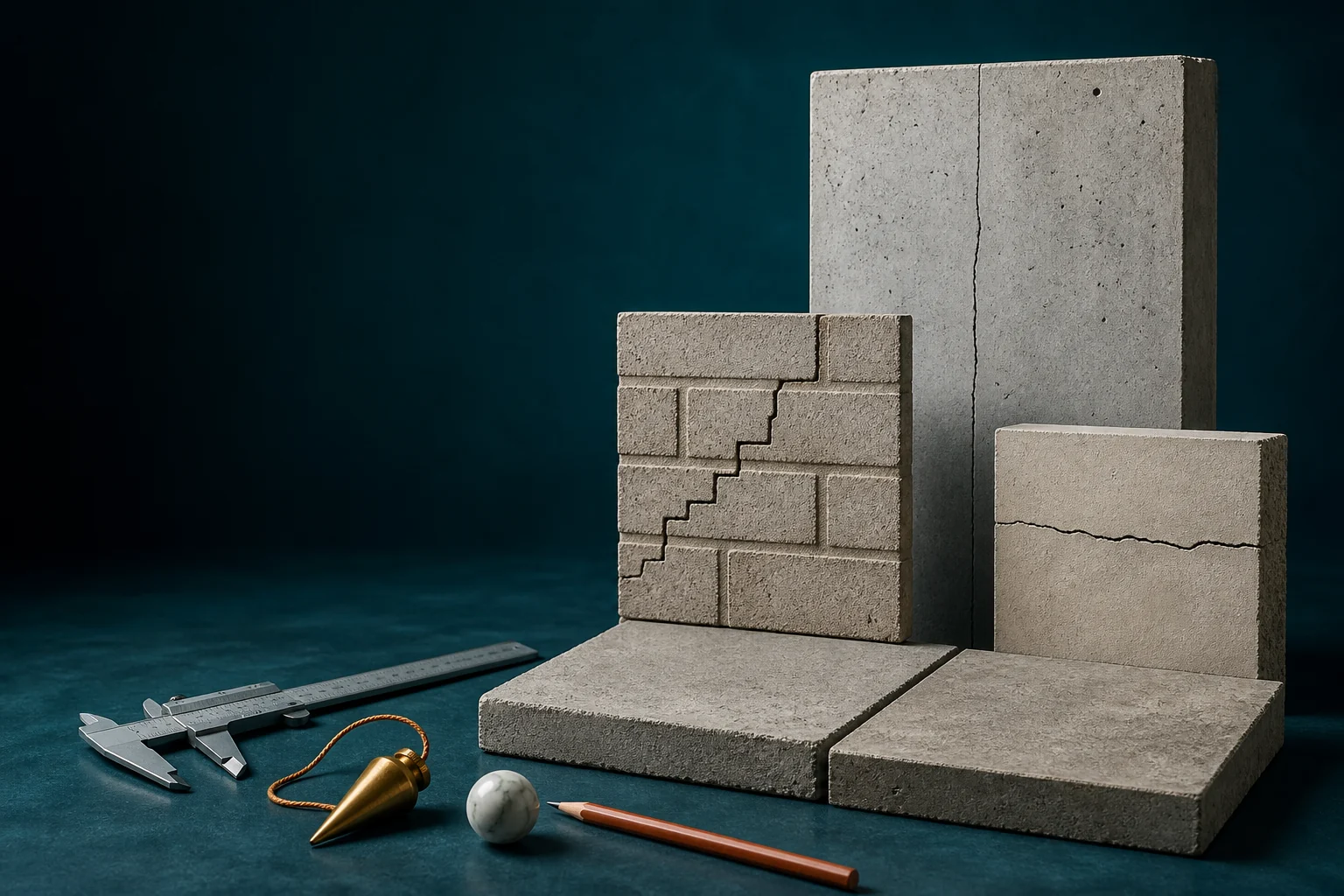
1–2 · Vertical cracks
Running straight up and down, or leaning a few degrees off vertical. The most common type and the least concerning. Concrete shrinks as it cures and relieves that tension by cracking vertically — usually in the first few years after the pour.
Under 1/16 inch, dry, not growing: cosmetic. Mark the ends with a date and check next season. See hairline crack in foundation.
1/16 – 1/4 inch, or damp: seal it. Polyurethane injection runs $350 – $900 professionally, or $60 – $150 as a DIY kit. Structurally still fine — you are managing water and radon, not stabilizing anything.
Watch for: a vertical crack that is noticeably wider at the top or bottom. That taper suggests one part of the footing has moved relative to another, which puts it closer to the diagonal category.
3 · Diagonal cracks
Running at roughly 30–75 degrees, very often starting at the corner of a window, door or utility penetration — the stress concentration points in any wall.
Diagonal cracking usually indicates differential settling: one part of the foundation has dropped slightly more than another. In a house under three years old that is often the tail end of normal settlement. In an older house, something changed — drainage, a tree, soil moisture, a nearby excavation.
What to do: monitor deliberately for a full season. Stable and under 1/4 inch, seal it and move on. Growing, or accompanied by sticking doors, get a structural engineer ($450 – $600) — settlement that is still active needs underpinning, not sealant, and that is a $5,000 – $30,000 conversation covered in foundation repair cost.
4 · Stair-step cracks
In concrete block or brick, cracks follow the mortar joints because they are the weakest path — producing the characteristic zigzag. The stepping itself is just the material; what matters is why the wall is stressed.
Narrow, stable, no bowing: often historical movement that has already stopped. Repointing the joints is reasonable maintenance.
Widening, or the wall bulges inward: lateral soil pressure is deforming the wall. This is structural. Sight down the wall's length from one end — a bow that is obvious from that angle is well past the monitoring stage. Repairs run $2,500 – $15,000; see basement repair cost.
Stair-step cracks in brick veneer only, with a sound foundation behind it, are a different and much cheaper problem — usually a lintel or the veneer's own movement.
5 · Horizontal cracks
A crack running horizontally across a basement wall — often near mid-height, where bending stress peaks — is structural regardless of how thin it is. It means soil outside is pushing the wall inward harder than the wall can resist.
Causes: saturated clay soil, poor drainage concentrating water against the wall, frost pressure, or heavy loads (a vehicle, a new patio, fill) too close to the foundation.
What to do: get a structural engineer, and get one before any contractor quote. Repairs range from carbon fiber straps ($2,500 – $7,000 for a wall bowing under 2 inches) to wall anchors ($4,000 – $15,000) to excavating and rebuilding ($20,000 – $40,000). Fixing the drainage that caused it is part of any repair that lasts.
6 · Offset or displaced cracks
One face of the crack sits proud of the other — run a finger across it and you feel a step. This means the wall has not merely cracked, it has moved. It is the clearest single indicator of active structural displacement, and it warrants an engineer regardless of width or direction.
Frequently paired with other symptoms: doors sticking in several rooms, sloping floors, gaps opening where wall meets ceiling. Read signs of foundation problems for the full walk-around, then price from a diagnosis rather than from a sales inspection.
Cracks in the basement floor or slab
Floor slabs are non-structural in most homes — they sit on the ground rather than carrying the house — so slab cracks are usually far less serious than wall cracks. Thin, meandering cracks in a basement floor are shrinkage, and extremely common.
Take them seriously when one side of the slab has settled lower than the other (a void beneath — slab jacking, $700 – $2,100), when water pushes up through them (hydrostatic pressure — see basement waterproofing cost), or when a slab crack lines up with a wall crack, which suggests both are responding to the same movement.
Ready to price your specific repair? The foundation repair cost calculator takes crack type, severity and home size and returns an itemized range.