What crawl space encapsulation costs
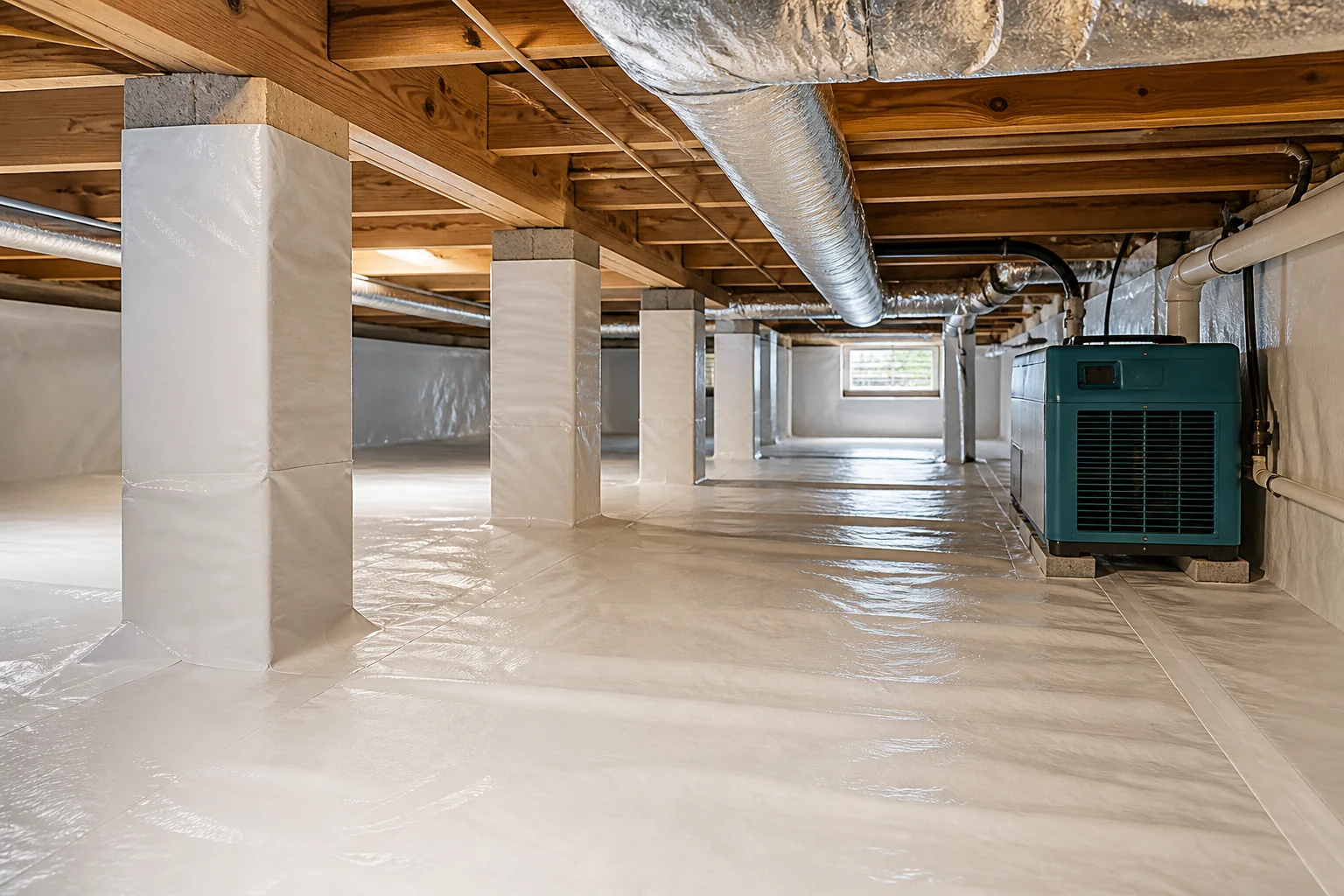
Full encapsulation runs $3,200 – $9,500 for a typical home — roughly $3 – $7 per square foot for a 12–20 mil barrier across floor and walls, taped seams, sealed vents and a dedicated dehumidifier.
A ground-only vapor barrier is $1,200 – $4,000, and for a crawl space that is already dry, it is sometimes the whole job. If there is standing water, budget $1,500 – $5,000 more for drainage — and fix that before anyone seals anything.
Cost by component
| Component | Typical range | Unit | What drives it |
|---|---|---|---|
| Vapor barrier, 6–10 mil (basic) | $0.5 – $1.2 | per sq ft | Thin — for dry spaces, tears easily |
| Vapor barrier, 12–20 mil (encapsulation grade) | $1.2 – $2.5 | per sq ft | Puncture-resistant, walls included |
| Seam taping & wall attachment | $0.4 – $1 | per sq ft | The step DIY jobs usually skip |
| Vent sealing | $40 – $120 | per vent | 4–10 vents on a typical home |
| Crawl space dehumidifier (installed) | $1,300 – $2,800 | per unit | Sized to volume, drain line required |
| Drainage matting / French drain | $1,500 – $5,000 | per project | Only if water pools |
| Sump pump for crawl space | $800 – $2,500 | per pump | Standing water present |
| Rim joist / wall insulation | $1.5 – $4 | per sq ft | Rigid foam or spray foam |
| Mold remediation (if present) | $1,500 – $6,000 | per project | Must happen before sealing |
| Debris removal & prep | $300 – $1,200 | per project | Old barrier, insulation, standing water |
Source: Compiled from published 2025–2026 contractor cost datasets and encapsulation material supplier pricing, normalized to installed cost including labor. · Last reviewed July 30, 2026 · Reference data · How we compile these figures
Cost by scope of work
| Package | Installed cost | Crawl space size | What’s included |
|---|---|---|---|
| Vapor barrier only | $1,200 – $4,000 | 1,000–1,500 sq ft | Ground sheeting. Dry crawl spaces with mild humidity |
| Standard encapsulation | $3,200 – $9,500 | 1,000–1,500 sq ft | Barrier on floor and walls, sealed vents, dehumidifier |
| Encapsulation + drainage | $5,500 – $15,000 | 1,000–1,500 sq ft | Adds sump, matting or French drain for standing water |
| Encapsulation + insulation | $6,000 – $16,000 | 1,000–1,500 sq ft | Conditions the space; best energy return |
| DIY vapor barrier (materials) | $500 – $1,500 | 1,000–1,500 sq ft | Barrier and tape only, your labor |
| DIY full encapsulation (materials) | $1,500 – $3,000 | 1,000–1,500 sq ft | Including a dehumidifier. Miserable but doable |
Source: Package totals assume an average 1,000–1,500 sq ft crawl space with 4–8 vents and standard access. Mold remediation, if needed, is additional and must be completed before sealing. · Last reviewed July 30, 2026 · Reference data · How we compile these figures
Is crawl space encapsulation worth the money?
It depends entirely on whether your crawl space is actually wet, and that is measurable rather than a matter of opinion. Buy a $15 hygrometer, leave it down there for two weeks, and read it.
Encapsulation earns its price when:
- Relative humidity sits above 60% for extended periods.
- There is visible mold on joists or subfloor, or a musty smell in the rooms above.
- Hardwood floors are cupping, or you have unexplained condensation on ductwork.
- The space is a rodent or insect highway — sealing genuinely helps.
In those cases, expect a real payoff: protected framing, noticeably better first-floor air (a large share of the air you breathe upstairs rises through the crawl space), and typically 10–15% lower energy bills when insulation is included.
You probably don’t need it when: the space measures consistently under 55% humidity, the wood is dry, and there is no odor upstairs. A well-drained, well-vented crawl space in a dry climate is doing its job. A sales inspection will still recommend encapsulation. Your hygrometer is the better witness.
Vapor barrier vs encapsulation — the actual difference
A vapor barrier is one component: plastic sheeting laid on the ground, usually loose-laid or lightly seamed, $1,200 – $4,000 installed. It slows ground moisture. It does nothing about humid outside air coming through the vents.
Encapsulation is the whole envelope: barrier across floor and up the walls, all seams taped, vents sealed, and a dehumidifier keeping the space conditioned. That last part is what actually controls humidity year-round — and it is what gets cut when a quote looks suspiciously cheap.
If a bid says “encapsulation” but has no dehumidifier line item, it is a vapor barrier with better marketing. Ask for both numbers separately.
Can you encapsulate a crawl space yourself?
A ground vapor barrier is realistic DIY: $500 – $1,500 in materials, one long weekend, and a tolerance for confined spaces. Full encapsulation is possible at $1,500 – $3,000 in materials including a dehumidifier, but it is genuinely unpleasant work — hours on your back in a 3-foot space. The full itemized comparison, including the three conditions that disqualify DIY entirely, is in DIY crawl space encapsulation.
The two failure points that make DIY jobs underperform:
- Unsealed seams and edges. Overlapping sheeting without taping it, or not sealing where the barrier meets the wall, leaves the moisture path wide open.
- Skipping the dehumidifier to save $1,300+. Without it, you have sealed humid air into an unvented space, which can be worse than doing nothing.
Have standing water or visible mold assessed professionally before sealing either way — encapsulating over an active water problem traps it against your framing.
Related: basement waterproofing cost, sump pump installation cost, foundation repair cost.